
Why Graphic Recording Is the Asset That Outlives the Event
A marketing strategist described a client's event to me last week.
Three weeks out. A hotel space, not a convention center. Fifty people: partners, prospects, customers, and maybe five media. A technical product demo. An executive doing a fireside chat.
"It will be completely fine," she said.
She's right. It will be fine. The demo will run. The executive will say true things. People will nod, take a business card, and drive to the airport.
And then, on Thursday, it's over. Whatever happened in that room stays in that room.
That's the part worth looking at.

Graphic recording of a live executive fireside chat by TwoLine Studios
What graphic recording actually is
Graphic recording is the practice of capturing a live conversation in words and images as it happens, in real time, in the room. A graphic recorder listens to a keynote, panel, or working session and synthesizes it into a large-scale visual while the conversation is still going. By the time the session ends, the summary already exists.
It goes by a few names. Live visual notes. Visual notes. Visual storytelling. Graphic facilitation, when the visual is being used to move a group toward a decision rather than document what was said. The distinction between those last two matters, and I'll come back to it.
What all of it produces is an artifact. Something that leaves the room.
What actually leaves the room
Fifty people were there. Five media might write something. The rest of the company, the rest of the customer base, the prospects who couldn't come, the sales team who needs this story next quarter: none of them were in the room.
So what reaches them?
A photo of a stage. A recap email nobody opens. A slide deck that gets forwarded twice and then sits in a folder.
The event ends and the content dies with it. That's the default, and most event budgets are built as though the room is the whole point.
The room is not the whole point. The room is where the thinking happens. What you make of that thinking is what does the work for the next twelve months.
Live visual notes produce that thing while people are still talking. The synthesis goes on social that afternoon. It goes into the follow-up email. It goes into sales enablement. It goes into next year's promotion for the same event.
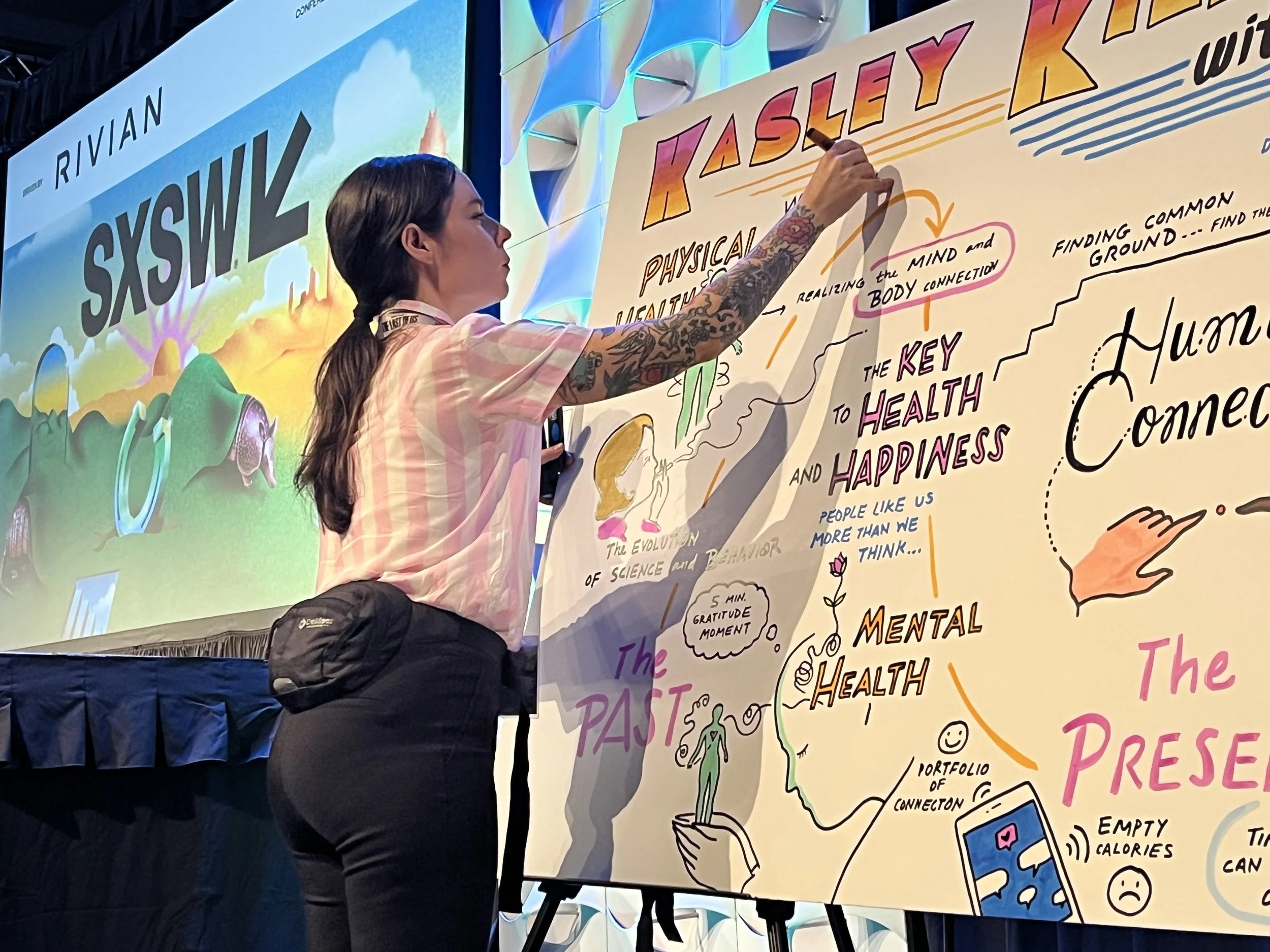
TwoLine Studios graphic recording at SXSW 2025
At SXSW 2025, where TwoLine Studios served as official graphic recorders across 14 sessions, the visuals reached 80,000 attendees on site. The post-event recaps were downloaded more than 2,000 times. Those visuals are still showing up in client leadership offsites, being used to ground the next decision.
One of my clients, a Minneapolis agency running an annual e-commerce forum, has done this four years running. Every year ends with a downloadable PDF of the visuals plus their own written takeaways. They give it to speakers as a gift. They use it as a brand asset all year. They use it to sell tickets to the next one.
The event is one day. The asset works for twelve months.
Small rooms raise the stakes
Here's what surprises people.
Events are getting smaller. Budgets are flat or cautious, and companies are trading the giant booth for a pop-up kiosk, an off-site dinner, a curated fifty-person room. I hear this from every events person I talk to right now.
The assumption is that smaller events need less. I'd argue the opposite.
At a forty-thousand-person conference, the event is its own marketing. It generates coverage, photos, and noise on its own. At a fifty-person off-site, almost nobody sees it live. Which means the thing that travels is doing nearly all the work.
Fewer people in the room raises the value of what leaves it.
There's a budget version of this argument too. A booth at a big show is mostly fixed cost, and companies are cutting it because the return is diffuse. A curated room where the client hand-picked every attendee already has better returns. Adding something memorable to a room where every person matters is a better bet than adding it to a room of four thousand badge scans.
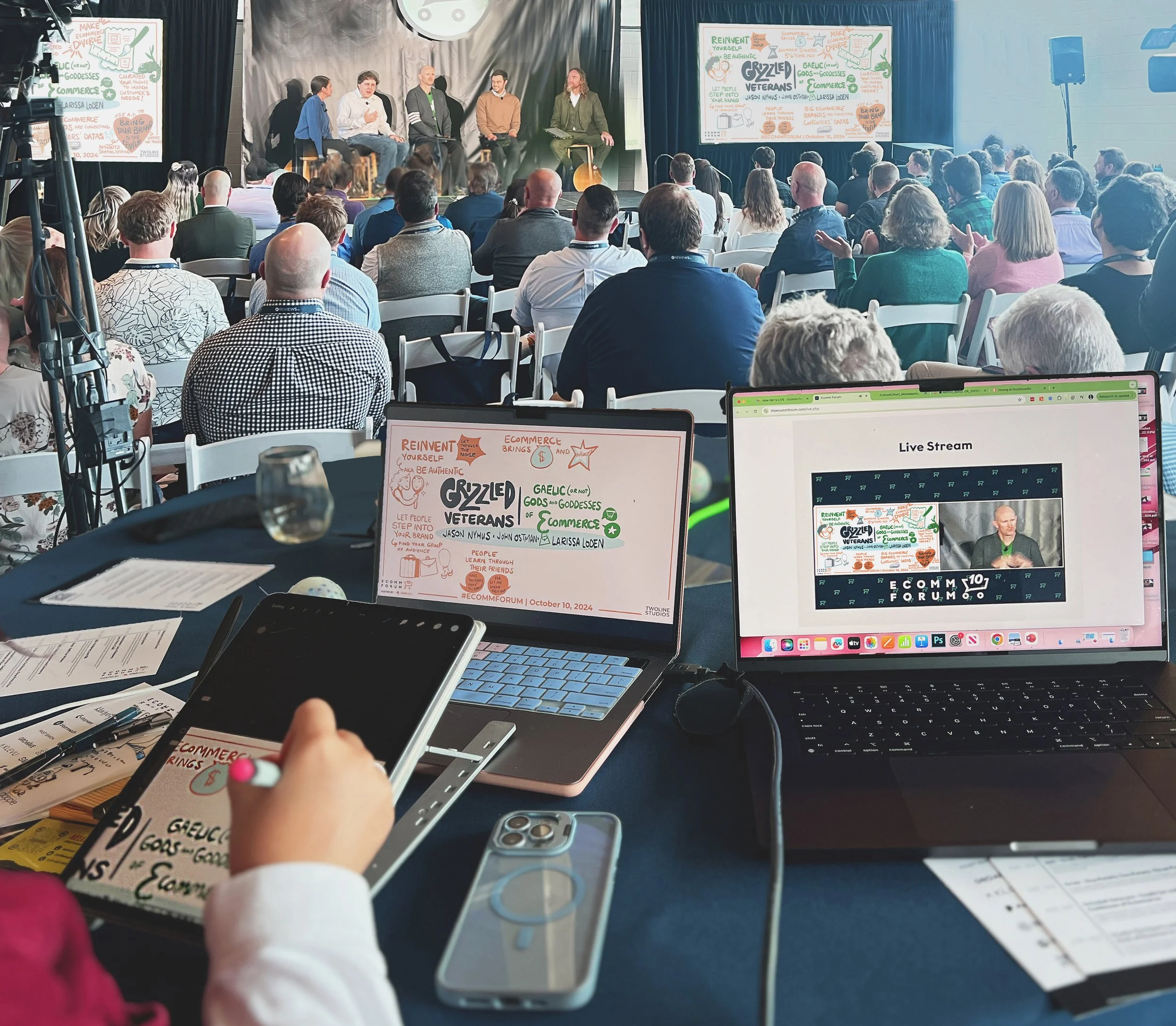
Live digital visual notes capturing a leadership session in real time
Why visual storytelling works, and why the usual explanation is wrong
Someone will tell you that people are different kinds of learners. Some are visual, some are auditory, some need to read it. Give everyone their channel and they'll retain more.
It's a lovely idea and the evidence doesn't support it. Pashler, McDaniel, Rohrer, and Bjork reviewed the literature in 2008 and found almost no studies designed well enough to test the claim, let alone confirm it. The studies since then, including a 2015 experiment on adults and a follow-up on fifth graders, found no relationship between a person's stated learning style, the method used to teach them, and how much they actually retained.
What is well supported is something better, because it applies to everyone.
Paivio's dual coding theory holds that we process words and images through two separate channels. Information encoded both ways gets recalled significantly better than information encoded one way. Richard Mayer's multimedia learning research has found this repeatedly: people who learn from words plus relevant pictures outperform people who learn from words alone, with effect sizes large enough that the finding has held across decades, subjects, and age groups.
Not because some people are visual. Because human beings have two channels and using both beats using one.
That's the actual case for putting a graphic recorder in a room. Not that it looks good, though it does. Not that it gives you social content, though it does. It's that the audience walks out holding more of what was said.
When it makes sense, and when it doesn't
It makes sense when you're already investing in the room. A summit, a customer advisory board, a leadership offsite, a partner day, an executive fireside. The venue is booked, the speakers are prepped, the invitations are out. A small addition to that budget changes what the whole thing produces.
It doesn't make sense when there's nothing to synthesize. Two people at a table with a laptop don't need a graphic recorder. Neither does a session with no real conversation in it.
The test is simple. Is there thinking happening in this room that nobody outside the room will ever see? If yes, that's the gap.
Graphic recording vs. graphic facilitation
These get used interchangeably and they're different jobs.
Graphic recording documents. Someone speaks, the recorder listens and synthesizes, and the room gets an artifact of what was said. The value shows up after the event.
Graphic facilitation intervenes. The visual is used during the session to help a group see where they disagree, name what's blocking them, and reach a decision they can act on. The value shows up in the room, while people are still in it.
Most events want the first. Most leadership offsites need the second. Knowing which one you're buying is most of the decision.
The question to ask
You've already committed the budget. The venue is booked, the executive has cleared the day, the demo is built, the invitations are out.
The question isn't whether to spend more. It's whether the thing you're about to spend all of that on will exist on Friday.
If the answer is no, that's the gap. And it's a small one to close.
Frequently asked questions
What is graphic recording? Graphic recording is the real-time capture of a live conversation in words and images. A graphic recorder listens to a keynote, panel, or working session and creates a large-scale visual synthesis while it's happening, so the summary exists by the time the session ends.
What's the difference between graphic recording and graphic facilitation? Graphic recording documents what was said and produces an artifact people use afterward. Graphic facilitation uses the visual during the session to help a group surface disagreement, find alignment, and make decisions. Recording delivers value after the event. Facilitation delivers it in the room.
Are live visual notes the same as graphic recording? Yes. Live visual notes, visual notes, and visualnotes all describe the same practice. Graphic recording is the term most used across the events and facilitation industry.
Does graphic recording actually improve retention? The research behind it is dual coding theory, not learning styles. Allan Paivio's work and Richard Mayer's multimedia learning research both show that information presented in words plus relevant images is recalled better than words alone, for people generally rather than for a "visual" subset. The learning styles claim, that matching instruction to a person's preferred channel improves outcomes, has failed to hold up in controlled studies since Pashler and colleagues reviewed the evidence in 2008.
What kinds of events is graphic recording worth it for? Events where you're already making a real investment and where meaningful conversation is happening: leadership offsites, customer advisory boards, partner summits, executive fireside chats, annual conferences, strategy sessions. It's not worth it for small booth activations or sessions with no substantive discussion to synthesize.
What do you get afterward? High-resolution visuals for social and email, a downloadable recap PDF, assets your sales team and partners can re-share, and a visual record you can use to promote the next event.